The short version
Plenty of groups picked their scheduling tool years ago, and a lot has changed since. If yours is Lightning Bolt, now part of PerfectServe, here is how it compares with Durate.
We cover what each one is, how they work, and which group each fits. We've moved groups off Lightning Bolt onto Durate, and this is what we learned. In a hurry:
Lightning Bolt vs. Durate at a glance
Durate is a scheduling-first system for physician groups, built on dynamic scheduling. It generates the schedule, keeps it reliable as the program changes, and tracks everything around it.
Lightning Bolt is the scheduling product inside PerfectServe’s clinical communication platform: Lightning Bolt Solutions was founded in 2002 and built its name on schedule generation, and PerfectServe acquired it in 2019.
| Durate | Lightning Bolt (PerfectServe) | |
|---|---|---|
| Best for | Medium and large provider groups, especially multi-site whose programs change month to month and are looking for a consolidated automated system. | Health systems standardizing on PerfectServe’s communication platform. |
| How it schedules | Dynamic. Plain English rules, one-click generation, and the system self-adjusts until the schedule is 100% done. | AI-enabled generation from rules and priority levels. In the groups we moved, the generation wasn’t in use and the schedule was built by hand. |
| Integrations | 100+ integrations covering EHR, payroll, calendars, and SSO, including Epic, Oracle Cerner, and ADP. | Epic OpTime and Epic On Call Finder, Kronos payroll, Workday, New Innovations, Outlook, TigerConnect, and single sign-on, per its integrations page. |
| Provider app | iOS app rated ⭐⭐⭐⭐⭐ 5.0 of 5 across 8 ratings. | iOS app rated ⭐⭐⭐ 2.8 of 5 across 147 ratings. |
| Ease of use | Rules change in plain English, by you or with a Durate expert. The learning curve is small. | Set up with Lightning Bolt’s help and training, and changes go through you or its professional services. No plain-English rule editing described on its pages. |
| Who owns the rules | You do. Automatic rule suggestions come built in, and Durate experts are there anytime. | In the groups we moved, administrators were not adjusting the rules themselves. |
| Security | SOC 2 Type II, encrypted at rest and in transit, with SSO/SAML, role-based access, and MFA. | SOC 2, a Censinet approval based on HIPAA and NIST, AES-256 at rest, and TLS 1.2+ in flight, per PerfectServe’s trust page. |
| Audit trail | Every change is recorded with who, what, and when, ready to look up. | Schedule edits are logged since the last save, with timestamp and user. No history of rule changes is documented. |
| Implementation | Live in 2 to 4 weeks. Simulations and any tests you want run first. | Not published. |
| Pricing | The first call gets you a real number, sized to your group. | Per-seat licensing with no pricing published. Quotes go through sales. |
Durate is a dynamic scheduler and handles the whole schedule while the Lightning Bolt groups we moved ran it by hand
Lightning Bolt built its name on schedule generation, and its own pages describe an AI-enabled generator. In the groups we’ve moved off it, that generation wasn’t in use: the schedule was built by hand and Lightning Bolt held the result.
Run that way, it’s a static scheduler, and everything after the first draft is on you.
Running Lightning Bolt month to month
Every change landed on the published schedule, and the administrators carried it by hand. None of it became a rule.
Whether that’s the product or the setup, we can’t say from the outside. What we can say is why groups call us about Lightning Bolt: the generation isn’t working fully for them.
Because of this, the Lightning Bolt teams we’ve seen typically:
- Build the schedule by hand.
- Use Lightning Bolt to hold and publish the result.
Groups that stay on Lightning Bolt are typically either:
- Health systems standardizing on PerfectServe end to end, where the schedule exists to feed the communication layer.
- Groups with administrators who have the time to finish the schedule by hand.
How Durate handles change
Durate is built so the generation is the part you actually use. We set the system up with you, your schedulers define what a good output looks like, and after that one click generates the schedule. A change in the program is a rule edit, and the system reshapes the schedule around it on its own.
The mid-cycle stuff is covered too. Time-off requests that fit the rules are honored automatically, swaps and open shifts happen in the provider app, and the AI catches unusual requests and coverage gaps before they become holes.
Monitoring runs in the background, and the target is under 30 minutes of schedule review a month.
Lightning Bolt groups we moved finished the schedule by hand. Durate is built for everyone in the group
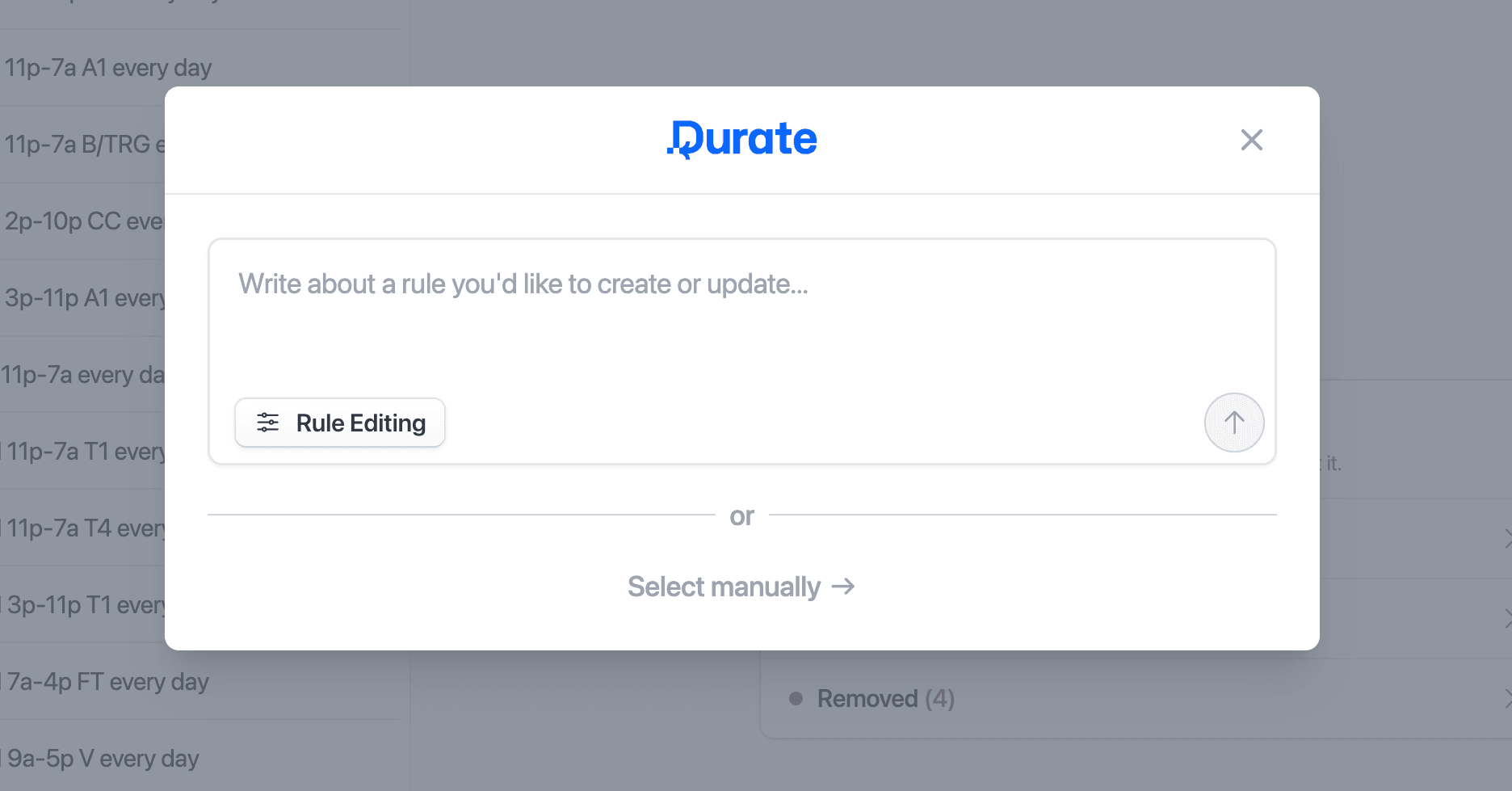
Describing the change is the whole job in Durate. You type it in plain English, the AI turns it into a rule, and the schedule rebuilds. Anyone in charge can do this with no real learning curve, and working with a Durate expert is included for free whenever you want it.
The same goes for reports. Ask about coverage, hours, or trends and the AI brings the numbers back.
In the groups we moved off Lightning Bolt, the administrators were not adjusting the rules themselves.
Lightning Bolt’s own pages describe rules and priority levels set up with its help and training, and changes made either by you or through its professional services. None of them describe changing a rule in plain English.
The other big difference is the mobile app, below.
How do the provider apps rate right now?
Public App Store ratings as of August 26, 2026. Durate’s 5.0 comes from 8 ratings, so treat it as an early signal. Lightning Bolt’s 2.8 across 147 is the number with weight behind it.
Durate is built to help run your whole scheduling operation while Lightning Bolt is one module of a communications platform
Lightning Bolt it is one of five product categories at PerfectServe, whose product line runs from clinical communication and answering services to provider scheduling. Durate is an independent, scheduling-first company.
Beyond generation, the features cover the rest of the operation:
- Rules in plain English that stay editable as coverage gets more complex.
- AI monitoring that writes your reports and flags what looks wrong: unusual requests, abnormal patterns, and coverage gaps in the weeks ahead.
- One-click generation, tuned with simulations before go-live.
- A provider app with swaps, open shifts, preferences, and real-time updates.
- Tracking that calculates PTO, hours, incentives, and per diem spend automatically as the schedule runs.
- Analytics and reports for coverage, hours, and trends, out of the same data.
- Integrations with Epic, Oracle Cerner, and ADP.
A rule change made by you, with a Durate expert, or through the AI lands the same way. The setup gets you 100% of the way there, not a half complete version.
Durate’s cost is a number on the first call while Lightning Bolt’s real cost is the hours spent finishing the schedule by hand
PerfectServe does not publish Lightning Bolt pricing: it is licensed per seat and quoted through sales, and the monthly figures on software-listing sites do not trace to PerfectServe.
Here are some big caveats after the quote:
- Run the 30-minute test. More than 30 minutes of adjusting each cycle means a static system, and those hours are someone’s salary. Durate keeps the checking afterwards minimal.
- Hand edits after generation are how rules get broken by accident.
- Time spent patching the output is time not spent designing the program.
Durate shows you a working version before a contract is signed, and the number you get on the first call covers revisions, support, and additions. No hidden fees.
Durate syncs with the EHR and payroll systems around the schedule
Integrations come up in every demo. Durate connects to Epic, Oracle Cerner, and ADP, plus 100+ more, and they've held up in Durate's deployments. Custom integrations are available when the data doesn't fit the common mold.
Lightning Bolt’s integrations page lists Epic OpTime and Epic On Call Finder, Kronos payroll, Workday, New Innovations, Outlook, TigerConnect, single sign-on, and an API framework for custom work.
Its Epic On Call Finder feed is file-based: a .csv over SFTP. Cerner and ADP are not named.
If Lightning Bolt doesn’t offer the integration you need, you’ll probably end up reconciling the data sync yourself.
Both are SOC 2 audited, with different strengths
PerfectServe publishes a strong security posture: SOC 2, a Censinet approval based on the HIPAA and NIST frameworks, AES-256 encryption at rest and TLS 1.2+ in flight, and a complete audit trail for message activity.
On the Durate side: SOC 2 Type II, with the full report available under NDA, encryption at rest and in transit, and support for SSO/SAML, role-based access control, and multi-factor authentication.
Durate's edge is that the rules are audited, not just the schedule. Every change is logged with who, what, and when, and the people making those changes are your own administrators.
PerfectServe documents an audit trail for messaging, and Lightning Bolt’s support center documents a change log for schedule edits since the last save, with timestamp and user. A history of rule changes is not described.
Lightning Bolt vs. Durate: which is right for your group?
Lightning Bolt is often a good fit for communications-first groups, where communication features come first and scheduling is not the highest priority.
Durate is for groups where scheduling is the hard problem, the program changes month to month, and the administrators want the rules in their own hands.
Choose Lightning Bolt if:
- Communications are at the center of your needs.
- You have administrators with the time to finish the schedule by hand.
- You want a standardized platform and do not expect to change the rules yourselves.
Choose Durate if:
- Scheduling is the hard problem, and you want it handled by an independent, scheduling-first company, with payroll tracking and analytics included.
- Providers move between your sites, and you want one system across all of them with hours tracked accurately.
- You want to go live in 2 to 4 weeks, with the rules proven before the first real schedule.
- Your own team should be able to change a rule in seconds and rebuild the schedule from it.
Checking the fit is cheap: Durate generates a sample schedule from your own coverage requirements and rules, usually on the first call. For what to look for beyond that, read the guide to dynamic physician scheduling.
Frequently asked questions
Is Lightning Bolt part of PerfectServe?
Yes. PerfectServe, a clinical communication company, acquired Lightning Bolt Solutions in 2019, and it operates as PerfectServe’s physician-scheduling product.
Is Lightning Bolt Best in KLAS for physician scheduling?
Yes. Lightning Bolt holds the 2026 Best in KLAS award for physician scheduling. KLAS scores come from the healthcare organizations that buy and run the system, so weigh the provider side too, where the iOS app rates 2.8 of 5 across 147 ratings as of August 26, 2026.
How much does Lightning Bolt cost?
PerfectServe doesn’t publish pricing. Lightning Bolt is licensed per seat and quoted through sales. Third-party sites that list specific monthly prices don’t trace those figures to PerfectServe, so treat them as guesses.
What are the best Lightning Bolt alternatives for physician groups?
Durate for medium and large multi-site and single-site provider groups whose hard problem is the schedule and whose administrators will change the rules themselves. QGenda fits groups whose hard problem is credentialing or capacity rather than the schedule. ShiftAdmin or Amion fit smaller, simpler programs, and Intrigma, ByteBloc, or Petal Health cover the niche fits.
What is the best scheduling software for medium and large multi-site and single-site provider groups?
A multi-site group needs three things at once: hours tracked accurately as providers move between sites, one system that spans every site, and one source of truth from scheduling through payroll. The multi-site groups we've switched used to hand each site to its own administrator, and nobody held the whole picture. Durate is built for that shape of group.
Does Durate integrate with Epic?
Yes. Durate connects to Epic along with Oracle Cerner, ADP, and the other main EHR and payroll systems groups run on.
How long does Durate take to implement?
2 to 4 weeks. The system gets set up with your team, simulations and any tests you want run first, and it comes back ready, with your administrators owning rule changes from day one.
Can a small single-site group use Durate?
It depends on the schedule more than the headcount. Durate pays off where the complexity is: multiple sites, floating providers, one system spanning all of it. A small single-site group with a simple schedule may be fine on something lighter, and we have said that to groups before. Book a call and we will walk through yours and tell you either way.