The short version
With all of the recent acquisitions and changes in healthcare software, many hospital administrators are looking at new options for their scheduling software.
Every competitor fact is linked where it appears, and the ratings and pricing status were checked last in August 2026.
This guide ranks the physician scheduling software by a few of the factors that matter most to medical departments. It covers the kind of group each scheduler fits, how each generates schedules, how the provider apps rate, what each costs, and how to choose. In a hurry:
Static vs. dynamic scheduling: why the engine matters
While most of the systems here that generate schedules are rules-based, there is still a good amount of confusion amongst hospital administrators about the differences and generally how they function.
We thought we'd write this article to explain the differences as the engine itself is the most important part of finding the right fit for a department because it determines exactly how the schedule is built. More importantly, it determines how reliable a system is and if it'll work for your program. Below, I'll go through every option you have and the tradeoffs of each.
Starting off, there are generally three types of optimizers when it comes to physician scheduling:
Static optimization
With static optimization, your team gets an interface where you put in the rules and requirements, and an algorithm assembles a schedule that satisfies your rules. That's the approach Lightning Bolt built its reputation on, and it has been the common approach for the last 20 years.
The part that doesn't get talked about enough is that you are completely responsible from start to finish. Putting in the rules, deciding the weights, making sure you're getting the right outputs, etc.
Anyone who's worked on this approach knows that most of the benefits of optimization get traded off when you have to spend hours on hours adjusting rules, getting the system to respect your inputs, and patching up a schedule that was only 70% of the way generated.
Nothing is more frustrating than spending hours in front of your computer fixing everything by hand, which is why a lot of the schedulers Durate has seen on tools that take this approach (QGenda, ShiftAdmin and Lightning Bolt) oftentimes opt to do their schedule by hand instead.
Static optimization sounds like the right path but is one of those approaches that just doesn't scale well for medium to larger programs that need reliability and don't want to spend all of their time fixing instead of deciding what is best for their program.
Pros:
- You have a full control panel
Cons:
- Gets outdated fast
- Once outdated, most programs move to manual scheduling instead
- Only gets you ~70% of the way there
- Hard to determine what input gets what outcome
Static with services
One alternative that came up because of this problem is called static with services: it's where scheduling sits inside a whole platform along with dozens of other modules, and configuration is services-led. You pay a much, much higher fee and instead work with consultants to get the system set up directly, per QGenda’s published approach.
On paper, this again looks like a good approach but has some key issues associated with it. And it's simply because programs change.
It's possible to get the first setup functional, but the real pain comes when a provider leaves, a new one comes, coverage moves, or there is even the slightest change in the program. When this happens the whole generation unravels and you have to pay again to bring someone in. Essentially it's the same problem as static scheduling except you're bringing in more people.
Money aside, this approach also makes schedulers commonly feel like they have to walk on eggshells around their schedule because any change they'll want to make means a round trip back to the consultants and weeks before they get the system fixed up again.
Pros:
- You get to work with someone directly
Cons:
- Breaks more as your program changes
- Extremely expensive and requires constant consulting
- Slowest turnaround times, especially bad for larger programs
Dynamic optimization
The newest approach in physician scheduling in 2026 is called dynamic optimization: this is a combination of the two above that is built to be run automatically and gets the benefits of both without any of the disadvantages.
The goal is to define a system with clear bounds, and then have AI-enabled features that allow anyone on the administrative team to easily make changes in plain English without breaking the system. Basically, the system is making the fine adjustments for you. You just direct it.
How it works is that when, let's say, coverage gets tighter, it can automatically pick up on that and adjust your program, and it can also accommodate “nice-to-have” rules in a way that a static scheduler can't support. It's also able to fully analyze your system at all times and pick up on problems proactively, which is something static scheduling just can't do.
The point here is that you have all the advanced mathematics designed into static scheduling to complete the schedule, but none of the downside of stale data or an unchangeable output. That's because the system is already adjusting itself and understands the limitations when you create rules.
Pros:
- Gets scheduling 100% of the way there
- Most optimal outcome mathematically
- Everyone on the administrative team can use it
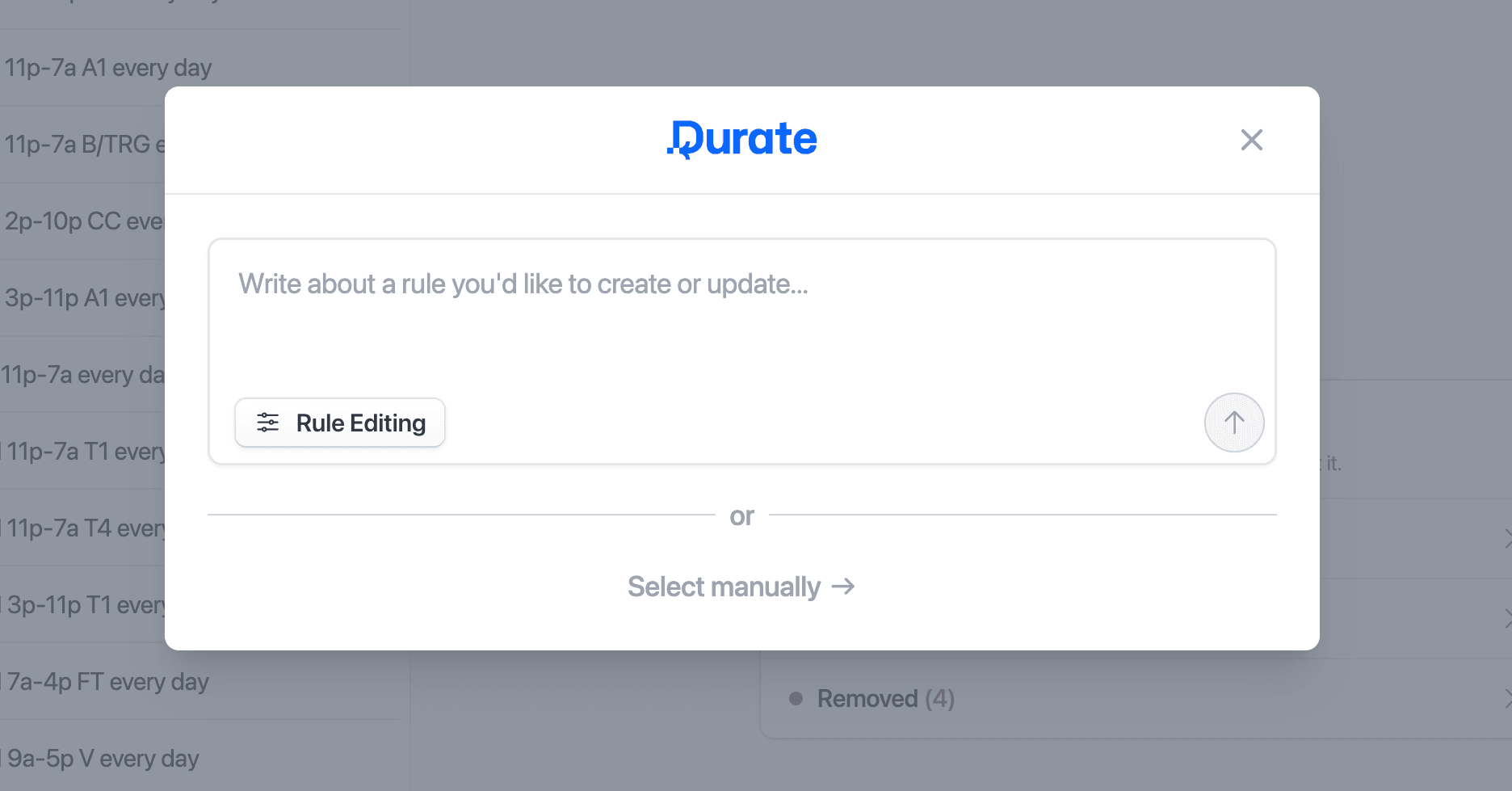
Your administrators write rules in plain English and the system generates and regenerates the whole schedule on demand. Durate works this way. The guide to dynamic physician scheduling explains it.
A static generator might be able to generate a working version once, and then require significant work to adjust, but a dynamic scheduler is the key to longer term reliability.
The key test to determine if a system is a static scheduler or a dynamic one is simply how much time it takes to complete your whole process. Most systems are fragile enough that they want you to fix the output instead of touching the input, so every fix goes into the schedule and next month you’re fixing the same things again.
If you find yourself spending more than 30 minutes a month scheduling after getting an output, you're most likely on a static scheduler.
What are hospitals moving to now?
Dynamic scheduling is now getting implemented in more and more hospital systems as administrators are trading in their legacy systems.
At Brown Emergency Medicine, the whole department recently switched off of their legacy static scheduler system to Durate's dynamic scheduler and runs their emergency room operations across 7 hospitals on the platform.
Schedule generation there is 1 click, and roughly 95% of monthly scheduling and operations run automatically. Schedulers are now freed up to think about the program's big picture goals instead of finding last minute swaps.
Large academic centers are not alone here: many medium and large emergency medicine departments, anesthesiology groups, cardiology teams, and more are realizing the benefits of dynamic scheduling and switching paths.
Which is the best physician scheduling software right now?
1. Durate
Scheduling Type: Dynamic scheduler
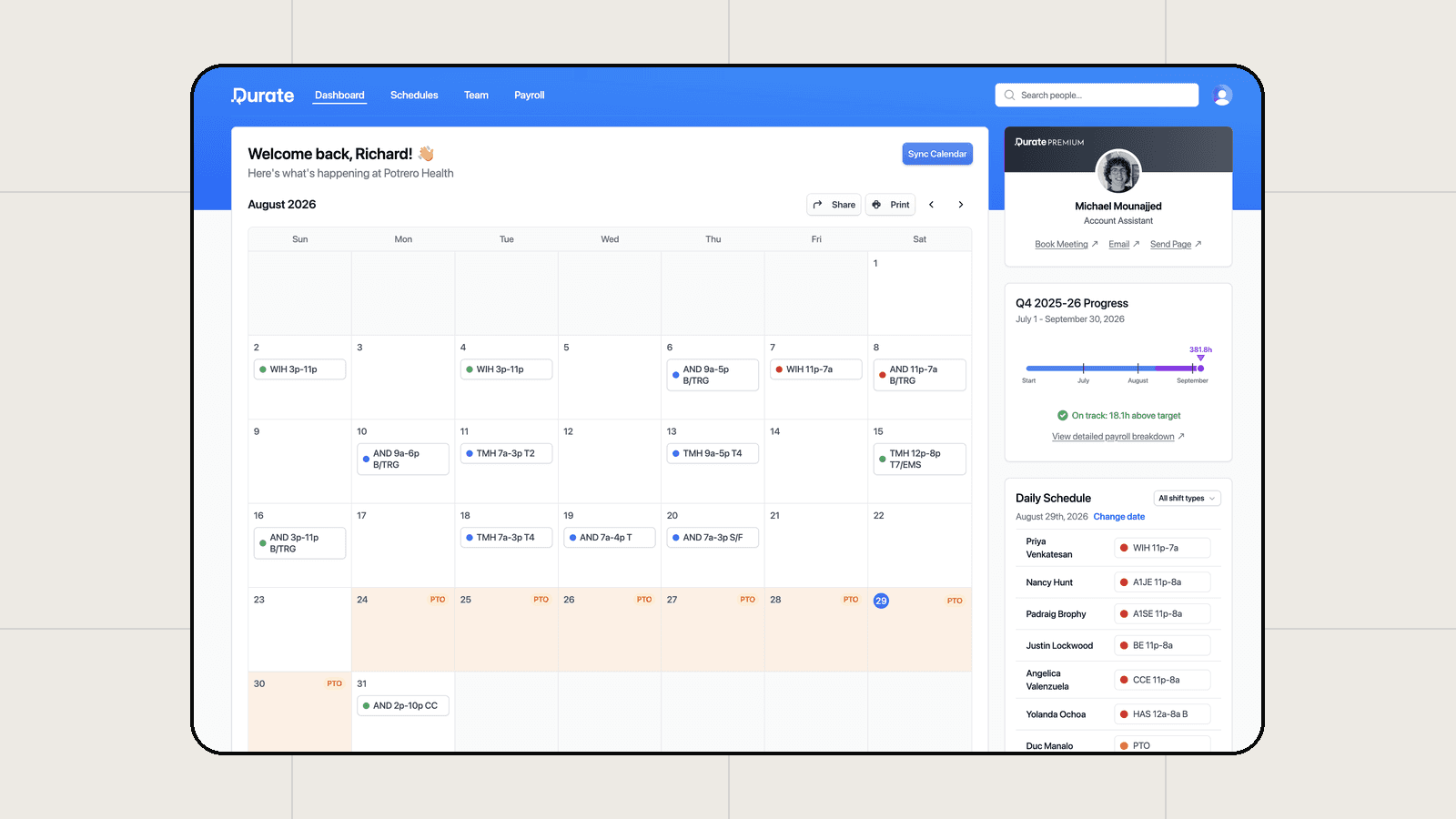
Durate is the original innovator of Dynamic Scheduling and currently has the best system for it. This system is especially useful for medium to large, multi-site provider groups whose hard problem is the schedule.
Durate is able to set up your system for you and get it running automatically in weeks with simulations for different outcomes. Rules are written in plain English, generation is one click, and your own administrators can adjust whatever they'd like. Scheduling, payroll tracking, and analytics all run in one system. Pricing is a real number on the first call, sized to your group.
Beyond generating the schedule, Durate's AI offers a range of advanced features: it changes rules from plain English, generates reports, flags abnormal patterns and unusual requests, and finds coverage gaps ahead of time, all for you.
2. Lightning Bolt (PerfectServe)
Scheduling Type: Static scheduler with services
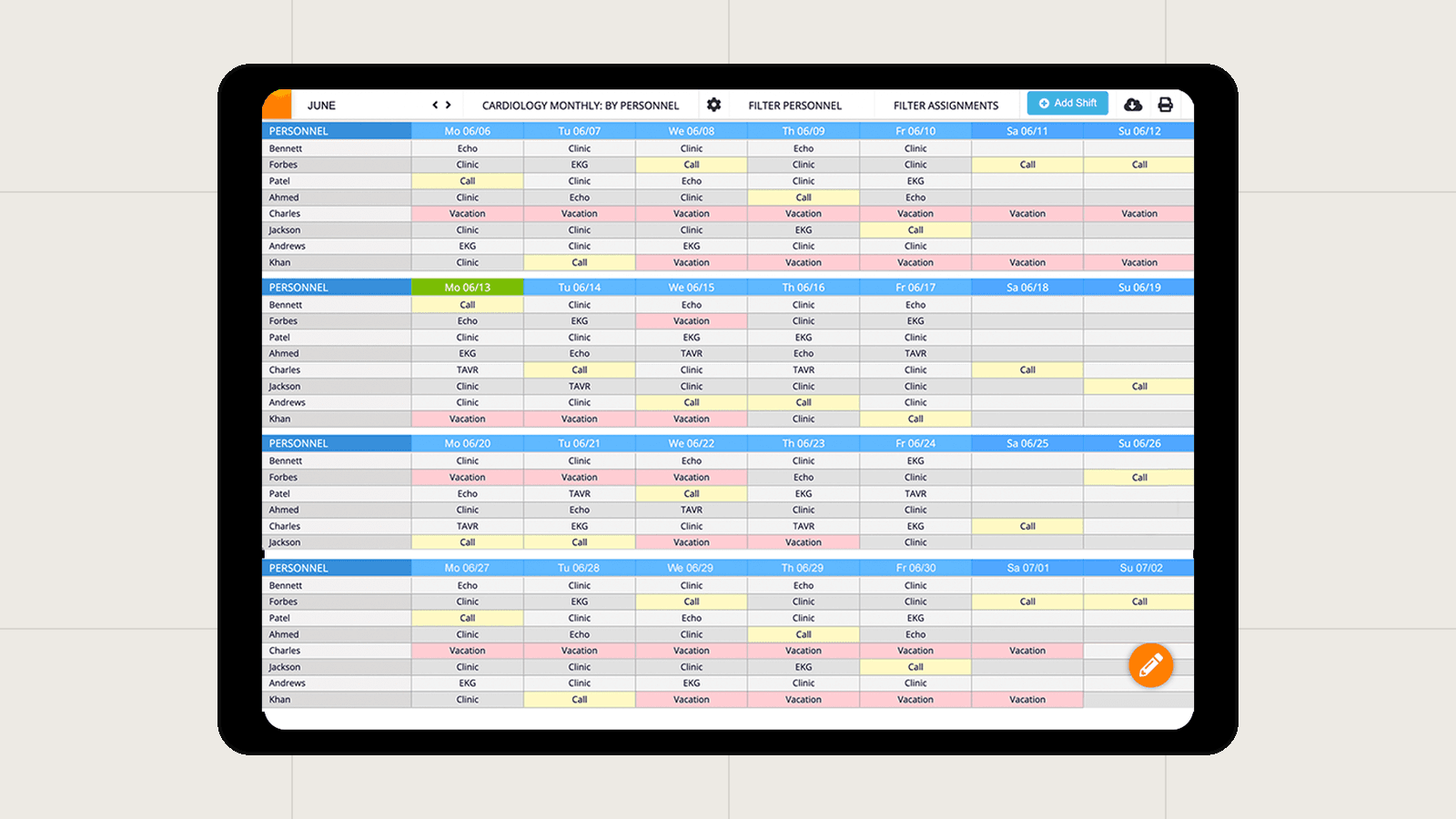
Lightning Bolt was acquired by PerfectServe, the clinical communications company, in 2019, and is a static scheduler. PerfectServe's product line is clinical communication, a medical answering service, an operator console, patient communication, and provider scheduling, where Lightning Bolt is the scheduling product. For a health system where automated scheduling is not the top priority, but linking to your communications systems is, Lightning Bolt is a solid contender.
Pricing is per seat and not published. The mobile app has the lowest ratings, but the website is used often. Full detail in the Lightning Bolt vs. Durate comparison.
3. QGenda
Scheduling Type: Static with services
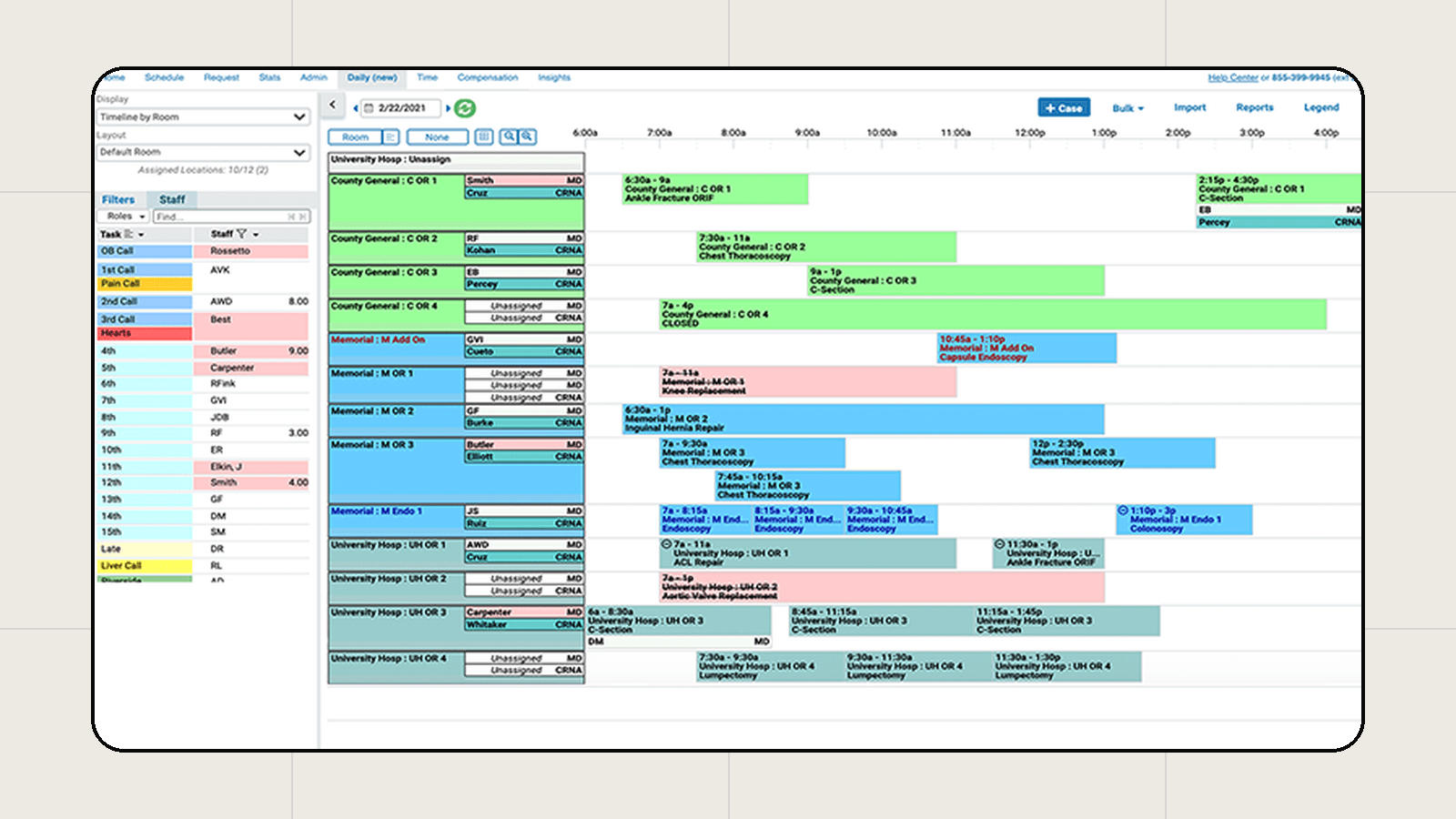
QGenda offers a wide set of products: scheduling, credentialing, on-call, capacity, time and attendance, and residency management. QGenda has been part of Hearst Health since the sale announced in August 2024. Its scheduling is a static, service-based approach, which is not as advanced as dynamic scheduling.
Pricing is quote-based and not published, and the groups that call Durate about it describe the cost as very high. Full detail in the Durate vs. QGenda comparison.
4. ShiftAdmin
Scheduling Type: Static
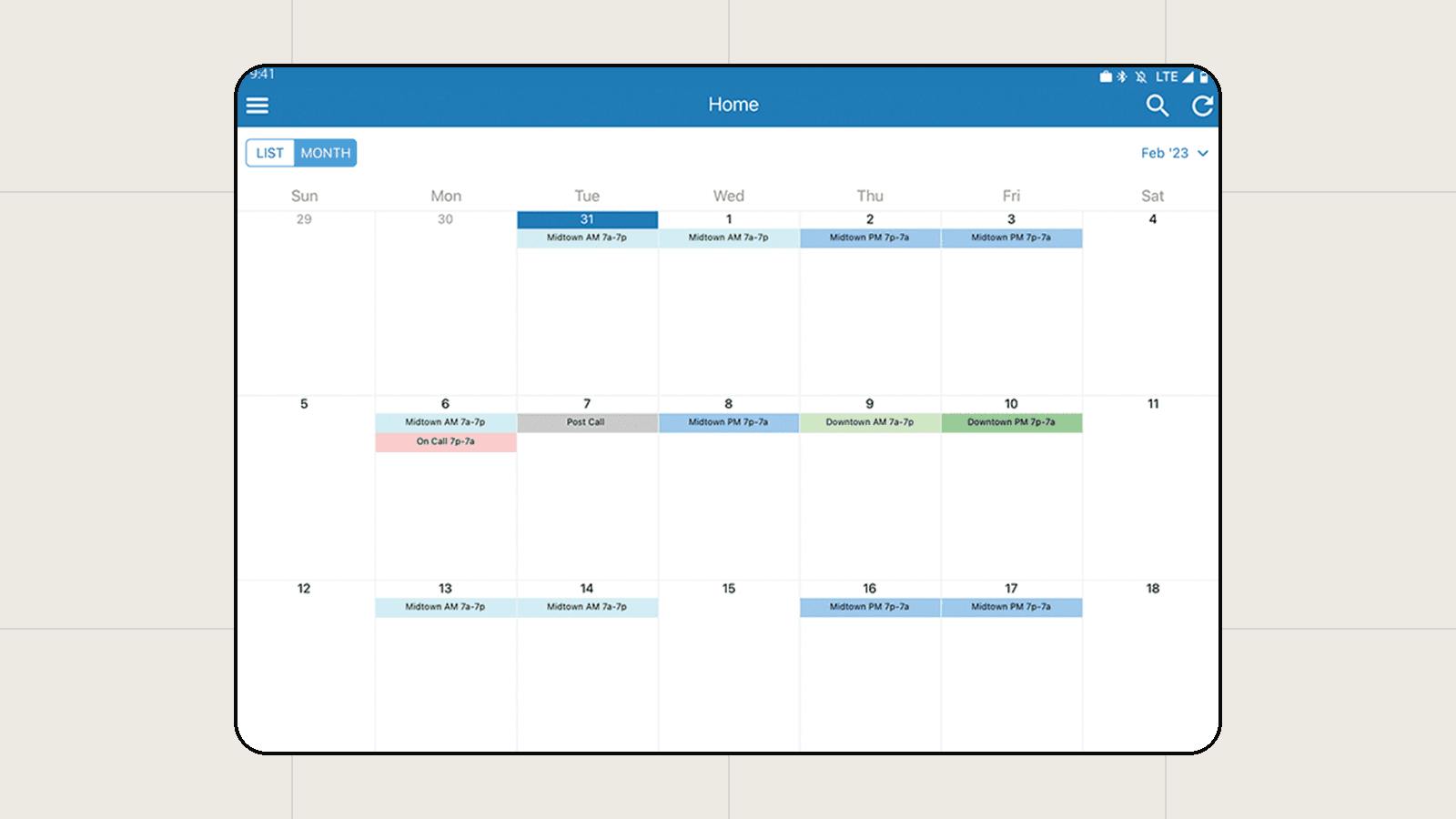
ShiftAdmin is one of the original innovators of static scheduling back in the day and has been owned by QGenda since 2021. It is the system new Durate customers most often arrive from. Pricing is not published, and quotes go through QGenda sales.
Full detail in the Durate vs. ShiftAdmin comparison.
5. Amion (Doximity)
Scheduling Type: No automatic scheduling
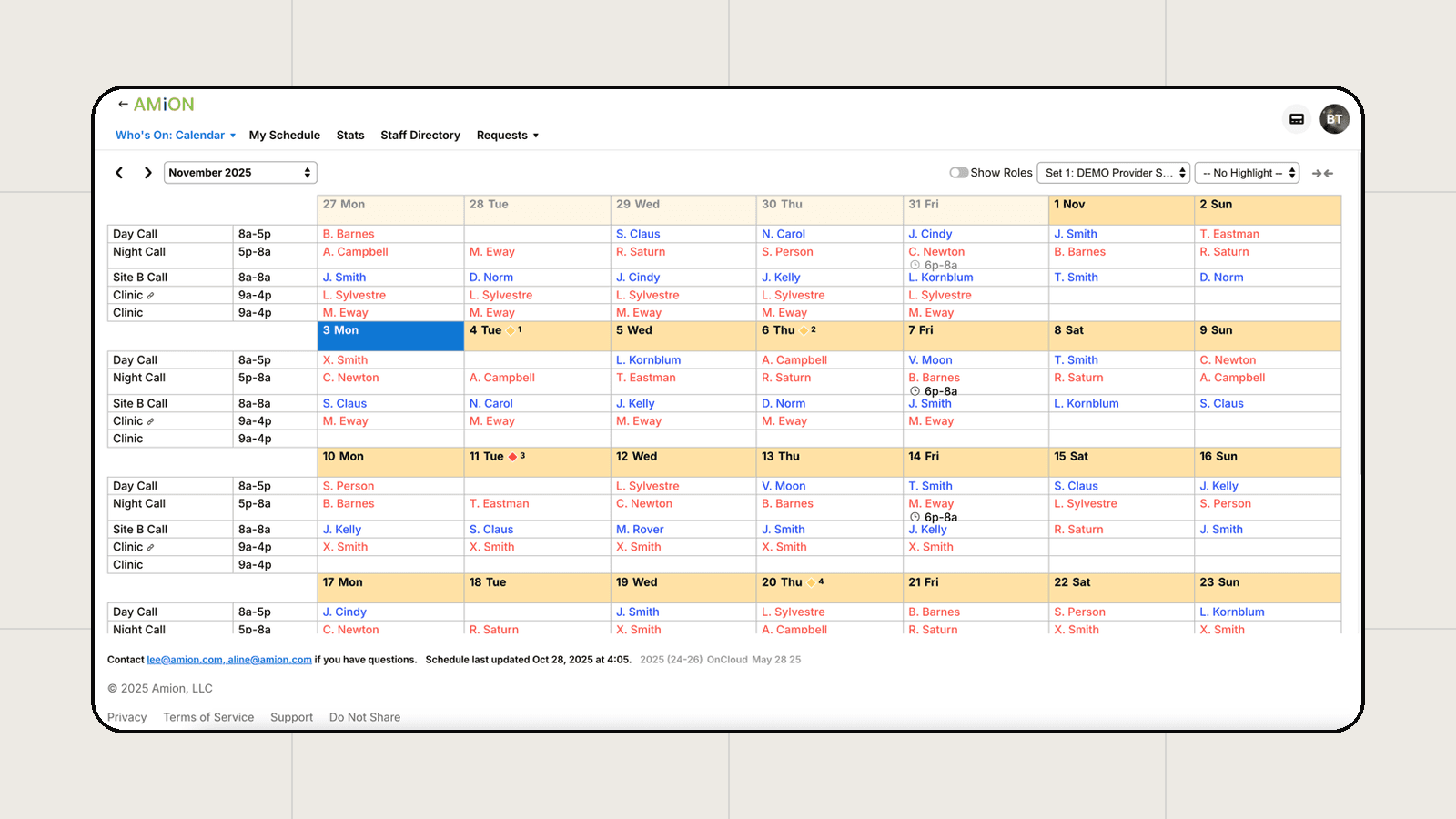
Best for a small single-site program with a few physicians, few changes, and a predictable structure, Amion, part of Doximity, is a great cheap alternative for groups that don't need automated scheduling at all. Its order page lists Pro, Enterprise, and Residency tiers without published prices as of August 2026. In the groups Durate has moved off Amion, the schedule was used as data storage more than a frontline tool, which is why complex multi-site groups tend to outgrow it.
How do the provider apps rate right now?
Public App Store ratings as of August 26, 2026.
The tools at a glance
Sources for every competitor fact are linked where that fact is mentioned on the page. App ratings are from the App Store as of August 26, 2026.
| Platform | How it schedules | Provider app (App Store) |
|---|---|---|
| Durate | Dynamic scheduler | 5.0 of 5 (August 2026) |
| Lightning Bolt | Static scheduler with services | 2.8 of 5 (August 2026) |
| QGenda | Static with services | 4.7 of 5 (August 2026) |
| ShiftAdmin | Static scheduler | 3.3 of 5 (August 2026) |
| Amion | No automatic scheduling | 4.4 of 5 (August 2026) |
How should you choose?
Choosing is not a simple ranking. The question really comes down to how important it is that you have a great schedule: one that is reliable and will not force you to constantly patch problems with the output.
Every current Durate customer came off a legacy tool that couldn’t keep up with a program that kept changing. So ultimately, if the best scheduling is your top concern, go with Durate.
But if the schedule isn't your hard problem and your program rarely changes, you likely don't need top of the line scheduling. And if you're six physicians in a department with few changes and a predictable structure, stay on a light tool.
One test if you're unsure: how long do you spend adjusting the schedule after it has been generated? 30 minutes or more likely means you have the wrong platform. So do excessive per diem usage, constant holes in your schedule, and constantly having to deny requests.
The adaptability to change is also a huge factor. Changes arrive from anywhere: a physician with an emergency at home, or the hospital changing coverage on certain shifts. If you think your program will have many changes in the future, a scheduler your administrators can adjust themselves is extremely important.
Not sure if you should switch? Here are some questions:
- How long does it take to patch a schedule now? If it's over 30 minutes, you likely have a static scheduler instead of a dynamic one.
- How much are you spending on per diems? Excessive per diem usage likely means you're not using your staff correctly.
- How do your staff feel about how much they're working? Do you have a burnout problem? That's likely a side effect of suboptimal scheduling.
- If a big program shift came tomorrow, how ready would you be? If you get worried at the thought of that, most of the anxiety might be around not being sure what's possible, which can be fixed with predictive analytics.
- Do you have to reconcile data across multiple platforms every month? It's possible to cut down that extra work and have everything automatically sync.
The bottom line
If you find yourself with any of these problems, your answer may be in a dynamic scheduling system, and particularly Durate. Durate works well for medium to large groups, particularly when there are multiple sites involved or complexity that's hard to configure.
If advanced generation is not important to you, there are other options, like Lightning Bolt, which is communications first, or Amion for people looking for a cost-effective way to input a schedule.
If you're looking for information about the benefits of dynamic scheduling, read the guide here: What is dynamic scheduling.
Frequently asked questions
What is physician scheduling software?
Physician scheduling software generates physician schedules from rules instead of having someone build them by hand: coverage requirements, fairness targets, and individual constraints go in, and a complete schedule comes out. The tools range from optimization engines like Lightning Bolt to suites like QGenda to systems like Durate, where your administrators write rules in plain English and regenerate the whole schedule in one click.
What is the best physician scheduling software?
If you run a medium or large provider group, multi-site or single-site, whose hard problem is the schedule, Durate is likely the best choice.
What is the most popular scheduling software?
No independent census of physician scheduling exists, and vendor user counts are marketing figures, not audited numbers. Popularity also doesn’t mean best for your group: group shape, multi-site complexity, and who owns the rules matter more than market share.
What is the most commonly used scheduling system?
No independent census of physician scheduling exists. What Durate can say from its own switches: ShiftAdmin is the system new Durate customers most often arrive from. Usage varies by specialty and group size, so a category-wide number says little about your group.
What is the most popular scheduling method in healthcare?
The traditional method, still widespread, is manual: templates and spreadsheets maintained by an administrator or a deputized physician. Static generation came next, where software produces a schedule once from rules and you patch it after every change. Dynamic scheduling is the newest method: rules are set once, the schedule generates in one click, and the system regenerates it as the program changes.
What is the best scheduling software for medium and large multi-site and single-site provider groups?
For a small single-site group the bar is lower, and a lighter tool can be enough. Multi-site is where the requirements stack up: providers need to move between sites with hours tracked accurately, one system needs to span every site, and scheduling through payroll needs one source of truth. Before Durate, the multi-site groups we have switched ran each site’s schedule through its own administrator or leader, so nobody held the whole picture. Durate is built for exactly that shape of group, and it does large single-site groups really well too.
Is automated scheduling better than manual scheduling?
At scale, yes. Durate schedules thousands of providers across 100+ sites. For a small group with simple coverage, a manual process or a light tool can still be adequate.
Does scheduling software replace our scheduling administrators?
No. Your administrators own the rules, and the software does the assembly. With Durate, your team sets rules once in plain English and changes them anytime, and the schedule regenerates in one click. The job turns from hand-building schedules into setting policy and handling the exceptions that need judgment.
Does Durate integrate with Epic?
Yes. Durate integrates with EHR and payroll systems including Epic, Oracle Cerner, and ADP.
How long does physician scheduling software take to implement?
With Durate, 2 to 4 weeks: setup happens with your team, simulations and any tests you want run before go-live, and the system is handed back ready to run, with your administrators owning rule changes from day one. QGenda’s setup is services-led: its implementation consultants configure the rules and workflows, per its published approach.
Can a small single-site group use physician scheduling software?
Yes, and which one depends on the schedule more than the headcount. Rules-based scheduling earns its keep where complexity lives: multiple sites, floating providers, one system spanning every site. A small single-site group with a simple schedule may be fine on a lighter tool, and we’ve said that to groups before. If you’re not sure which side you’re on, book a call and we’ll walk through your schedule and tell you either way.