The short version
With all of the recent acquisitions and changes in healthcare software, more hospital administrators are looking for alternatives as they feel like the tools they once relied on are no longer getting the results they were hoping for.
This guide directly compares ShiftAdmin and Durate, two commonly picked options in healthcare departments today. We go through what each one is, how they work, and if they're a good pick. In a hurry:
- ShiftAdmin vs. Durate at a glance
- Durate is a dynamic scheduler and handles the whole schedule while ShiftAdmin is static, and only gets you part of the way there
- ShiftAdmin needs a team of dedicated schedulers; Durate is built for everyone in the group
- How do the provider apps rate right now?
- Durate is built to help run your whole scheduling operation while ShiftAdmin lacks many key features
- Durate’s cost is a number on the first call while ShiftAdmin's cost shows up months later in your schedules
- Durate syncs with the EHR and payroll systems around the schedule
- Both take security seriously, with different strengths
- ShiftAdmin vs. Durate: which is right for your group?
ShiftAdmin vs. Durate at a glance
Durate is a dynamic scheduling-first system for physician groups, strongest in shift-based specialties, built around helping systems and groups scale automation across their entire department quickly and safely.
ShiftAdmin is a static scheduling system built for administrators to manage on their own: it generates from customizable rules and user requests, and you resolve the conflicts by hand after. ShiftAdmin was acquired by QGenda in 2021 and now operates under them. QGenda itself was sold to Hearst Health in a deal announced in August 2024.
Here’s a quick summary, but keep reading for more details.
| Durate | ShiftAdmin (QGenda) | |
|---|---|---|
| Best for | Medium and large multi-site and single-site provider groups and shift-based specialties whose program keeps changing. | Mostly small single-site shift groups under 25 people. Typical in programs that rarely change. |
| How it schedules | Dynamic. Rules in plain English, one-click generation, and the system autoadjusts so schedules come out 100% done. | Static. It generates from customizable rules and user requests, and you resolve the conflicts by hand after. |
| Integrations | 100+ integrations, from EHR to payroll to calendar sync and SSO. Epic, Oracle Cerner, ADP, and the main ones most providers and clinics use. | Calendar subscriptions plus RESTful API integrations with payroll, HR, and single sign-on, per its own 2021 overview page. No EHR integration listed. |
| Provider app | iOS app rated ⭐⭐⭐⭐⭐ 5.0 of 5 across 8 ratings. | iOS app rated ⭐⭐⭐ 3.3 of 5 across 71 ratings. |
| Ease of use | Change rules in plain English yourself, or have a Durate expert do it with you. Not much of a learning curve. | The scheduler sets up and adjusts the importance of rules. The learning curve is steep at the start and it stays steep as things change. |
| Who owns the rules | You do, with automatic suggestions and help anytime from Durate experts. | Your administration is fully responsible for making sure everything is set up and working. |
| Security | SOC 2 Type II, data encrypted at rest and in transit, SSO/SAML, role-based access, and MFA. | SOC 2 Type II, SOC 1 Type II, FedRAMP LI-SaaS, and HIPAA for QGenda, the parent company. |
| Audit trail | Every change is logged, and you can look up who changed what and when. | Not documented publicly. Its feature pages mention request date and time tracking and a role and permission system, but no change history. |
| Implementation | 2 to 4 weeks, with simulations and any tests you want before go-live. | Not published. |
| Pricing | You get a real number on the first call, sized to your group. | No pricing published. Quotes go through QGenda sales. |
Durate is a dynamic scheduler and handles the whole schedule while ShiftAdmin is static, and only gets you part of the way there
Running ShiftAdmin month to month
Most teams on ShiftAdmin bought it years ago, and when the program changes it’s hard to get predictable results out of the scheduling module. In practice, hospital departments end up with dedicated schedulers who spend most of their time adjusting and tweaking rules, then rerunning the generation until a workable version comes out. Even then, they still aren’t able to fully control the outcome, leading many to manually adjust the schedule afterwards.
Whichever way you want to schedule on ShiftAdmin, the trade-off is the same: some control once you’re past the learning curve, but a complex system to manage in exchange. Setup, updates, weights, patterns, penalties, rules.
The outcomes we've seen: schedules that don’t respect the rules you set, or outputs that just can’t work. It’s not uncommon to look up and find 600+ rules and inputs you forgot you put in years ago.
Because of this, ShiftAdmin teams typically:
- Generate a general templated version.
- Fix the rest of the schedule by hand.
That means if you’re in a large program, you won’t get most of the benefits of ShiftAdmin’s automation. Your time goes into fixing the rules or fixing the output instead.
Groups that stay on ShiftAdmin are typically either:
- Small, single-site, and shift-based, with a program that rarely changes and scheduling needs that stop at one department.
- Large, multi-site, shift-based hospitals that only use it as an initial template before doing most of the scheduling by hand.
How Durate handles change
Durate’s infrastructure is almost entirely different: Durate is not a static scheduler and instead uses dynamic scheduling.
Durate handles the last stretch to get the schedule fully complete for you: we work with you to define the system, and then your schedulers set output-based goals. From there, the schedule is trained to generate in one click, and when something changes you edit the rule and the system is able to make adjustments easily.
If something breaks mid-cycle, Durate deals with that too. Time-off requests are honored automatically when they fit the rules, swaps and open shifts run in the provider app, and Durate’s integrated AI system flags unusual requests and upcoming coverage gaps before they become a problem.
Durate also has intelligent monitoring to fix issues and take everything into account over time. Schedule review is meant to take under 30 minutes per month, and Durate has a reputation for delivering this across the thousands of providers and 100+ sites it supports.
With a static scheduler like ShiftAdmin, the schedule never really stops being your problem, and it takes a team to keep it running. Durate is meant to run on its own, reliably, and deal with the hiccups so you don’t have to.
ShiftAdmin needs a team of dedicated schedulers; Durate is built for everyone in the group
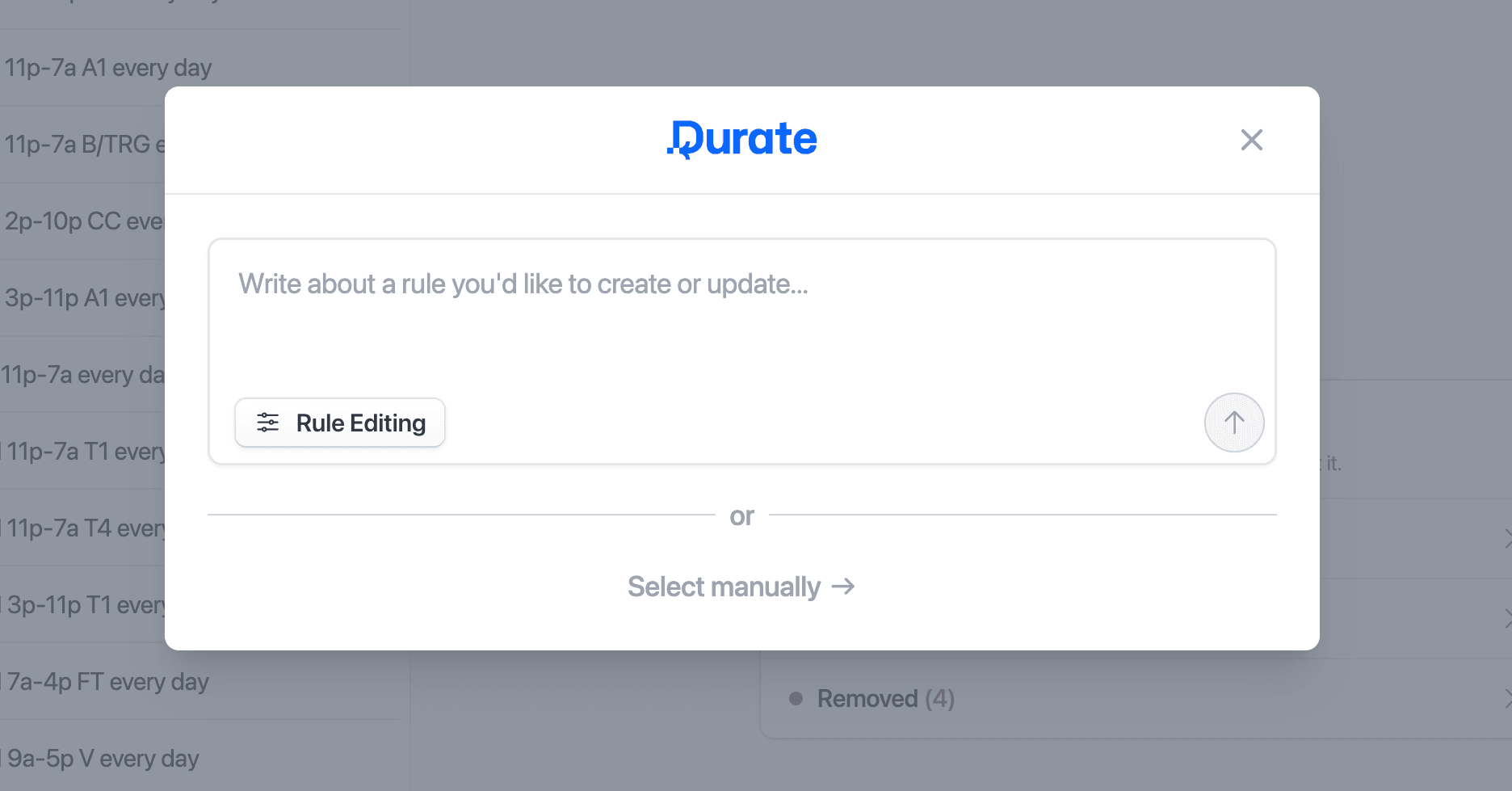
In Durate, rule changes are made with AI, in plain English: simply describe the change, and the schedule rebuilds from it. The system is largely built so all changes can be done by anyone in charge, with no large learning curve. You can also work with a Durate expert anytime, and that’s included for free.
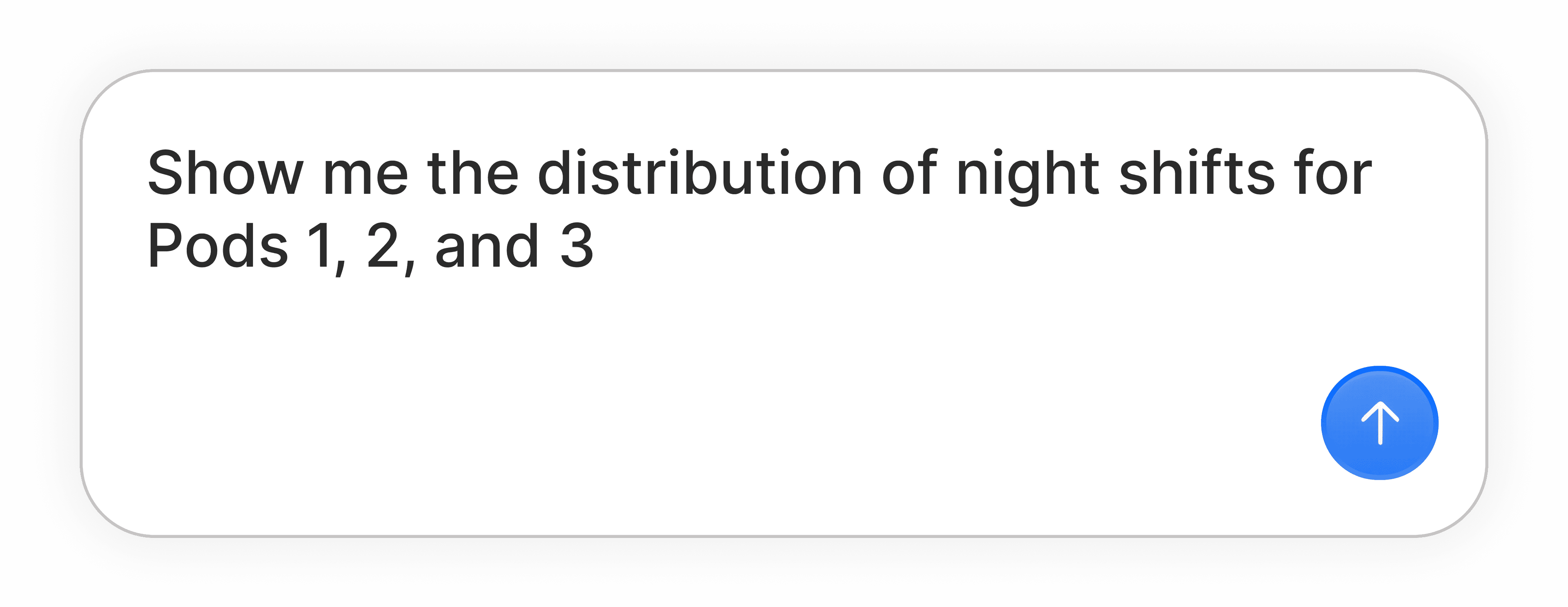
Reports work the same way: ask for coverage, hours, or trends across the department, and AI gathers the information for you.
ShiftAdmin requires administrators to carefully piece together information from across the platform to analyze trends. There’s a steep learning curve to getting started, and a second one to keeping it updated as the program moves.
ShiftAdmin’s own pages describe your administrators applying its 100+ built-in rules and per-shift settings.
Another key difference between the platforms is the mobile app, which is talked about below.
How do the provider apps rate right now?
Public App Store ratings as of August 26, 2026.
Durate is built to help run your whole scheduling operation while ShiftAdmin lacks many key features
ShiftAdmin treats scheduling as a module. The schedule lives there, but there are a few features around it.
Durate’s approach is different. It's entirely based around reliability first and keeping the system running for you with everything in one place.
Beyond generating the schedule, all of Durate's features work together to deliver the easiest experience for people in charge:
- Rules in plain English, even for the most complex coverage. They stay adjustable no matter how complicated the schedule underneath gets.
- AI that monitors rules, writes reports, and flags anything that seems off: abnormal patterns, unusual requests, coverage gaps coming up across the program.
- One-click generation, with simulations before go-live to find your group’s optimal settings.
- Provider app, rated 5.0 of 5 across 8 ratings, for swaps, open shifts, preferences, and real-time updates.
- Tracking for PTO, hours worked, incentives, and per diem spend. It all calculates automatically as the schedule runs.
- Analytics and reports on coverage, hours, and trends, pulled from the same data.
- Integrations with Epic, Oracle Cerner, and ADP.
Whether you change a rule yourself, with a Durate expert, or through the AI, you get the most powerful setup, one that gets you 100% of the way there instead of just a half-complete version.
Durate’s cost is a number on the first call while ShiftAdmin's cost shows up months later in your schedules
Neither ShiftAdmin nor QGenda publishes pricing. shiftadmin.com is a login portal.
Here are some big caveats after the quote:
- If adjusting the schedule takes 30 minutes or more each cycle, you’re likely running a static scheduling system. For reference, Durate is built so checking time afterwards is minimal. In a system like ShiftAdmin, that work falls to someone, the scheduler or a physician lead, and their time has a real cost worth calculating.
- Manual adjustments after generating typically cause accidental rule violations.
- By constantly readjusting, you spend much more of your time patching instead of designing what’s best for your department.
Durate helps get you a working version before you sign a contract, and all revisions, support, and additions are included in a single number on the first call, with no hidden fees.
Durate syncs with the EHR and payroll systems around the schedule
As far as we can tell, Durate and ShiftAdmin are fairly alike in this area. Both offer a wide range of integrations, from payroll systems like ADP and Paylocity to calendar syncing across Apple Calendar, Google Calendar, and Outlook. The difference is that Durate also links to EHRs like Epic and Oracle Cerner, which ShiftAdmin doesn’t list.
Another difference is that Durate offers custom integrations for groups whose data syncing doesn't fit the common mold. If ShiftAdmin doesn’t offer the integration you need, you’ll likely end up reconciling the data sync yourself.
Both take security seriously, with different strengths
Since ShiftAdmin is a part of QGenda, we pulled directly from their trust center: SOC 2 Type II, SOC 1 Type II, FedRAMP LI-SaaS, and HIPAA.
Durate is SOC 2 Type II compliant, and data is encrypted at rest and in transit. Durate also supports single sign-on (SSO and SAML), role-based access control, and multi-factor authentication.
Where Durate is stronger is the audit of the schedule itself: every change is logged, so you can look up who changed what and when, and ask about any of it. ShiftAdmin’s public feature pages mention request date and time tracking and a role and permission system, but they’re unclear about a full audit history.
ShiftAdmin vs. Durate: which is right for your group?
For a small single-site shift group with under 25 people where the program rarely changes and scheduling stops at one department, ShiftAdmin is likely enough.
Durate makes sense for the rest, who want a self-running system that is reliable as the program changes. Durate is also the right choice if you need the most modern analytics and scheduling features.
Choose ShiftAdmin if:
- You’re a small single-site shift group and the program rarely changes.
- The mobile app is not important to you.
- Your analytics needs are not as complex and you don't need insights or granular control.
Choose Durate if:
- You want a scheduling-first company with the day-to-day operations built in: scheduling, payroll tracking, and analytics in one system.
- Your schedule spans more than one site and you want one system across every site, with hours tracked as providers move between them.
- Your goal is to go live in weeks.
- You want to change the rules yourselves, quickly and with granular control, and have the schedule fully rebuilt from them.
To see if Durate is a fit, we can generate a sample schedule built from your own coverage requirements and rules. It usually comes on the first call.
Frequently asked questions
What is ShiftAdmin?
ShiftAdmin is scheduling software for shift-based specialties, mostly emergency medicine, hospital medicine, and urgent care. QGenda bought it in January 2021 and sells it today. There isn’t much of a public website left. shiftadmin.com is a login portal, so product questions, pricing included, go through QGenda.
Is ShiftAdmin owned by QGenda?
Yes. QGenda announced the acquisition on January 14, 2021, and the Shift Admin app is sold by QGenda, LLC today. QGenda itself was sold to Hearst Health in a deal announced in August 2024, so ShiftAdmin now sits under Hearst by way of QGenda.
How much does ShiftAdmin cost?
There’s no price list. Neither ShiftAdmin nor QGenda publishes pricing, so the only way to get a number is a QGenda sales conversation. If you do get a quote, it’s worth asking what ShiftAdmin costs on its own versus inside the suite.
Is ShiftAdmin still being developed?
The app is alive: iOS version 1.24 shipped in February 2026, and it sits at 3.3 of 5 across 71 ratings as of August 26, 2026. The website tells a different story, with no product or pricing pages. No sunset or migration plan had been announced as of August 2026. A long-term bet on ShiftAdmin is really a bet on QGenda’s roadmap.
ShiftAdmin vs. Durate: which should we choose?
Stay on ShiftAdmin if you’re a small single-site shift group, under 25 people, whose program rarely changes. Choose Durate if you run more than one site, the schedule itself is the hard problem, or you want your own team changing the rules. Either way, run this test: time how long you spend adjusting the schedule after it’s generated. 30 minutes or more each cycle means you’re running a static workflow.
What is the best scheduling software for medium and large multi-site and single-site provider groups?
Multi-site is where the requirements stack up: providers moving between sites with hours tracked in one place, one system across every site, and one source of truth from the schedule through payroll. Before Durate, the multi-site groups we’ve switched ran each site’s schedule through its own administrator or leader, so nobody held the whole picture. Durate is built for exactly that shape of group, and it does large single-site groups really well too.
Does Durate integrate with Epic?
Yes. Durate integrates with EHR and payroll systems including Epic, Oracle Cerner, and ADP. Integrations are the thing groups worry about most in the demo, and in Durate’s deployments they’ve worked.
How long does switching from ShiftAdmin to Durate take?
2 to 4 weeks. Durate rebuilds your rules with your team, runs simulations and whatever tests you want before go-live, and hands the system back ready to run, with your administrators owning rule changes from day one. You’ll also see a sample schedule built from your own coverage requirements, usually on the first call.
Can a small single-site group use Durate?
It depends on the schedule more than the headcount. Durate earns its keep where complexity lives: multiple sites, floating providers, one system across all of them. A small single-site group with a simple schedule may be fine on a lighter tool, and we’ve said that to groups before. Book a call and we’ll walk through yours and tell you either way.